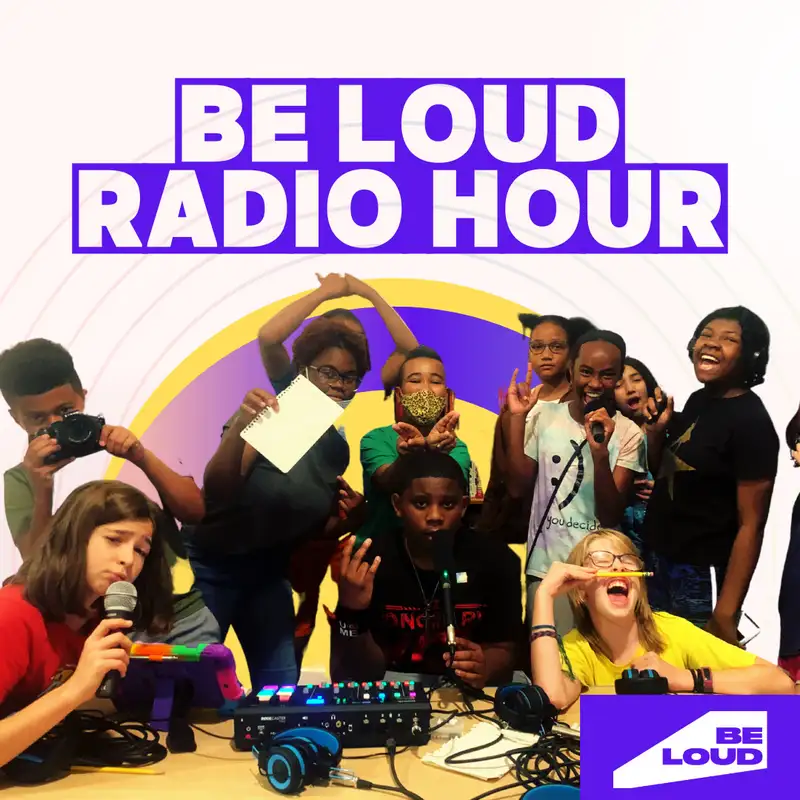
Be Loud Town Hall Part 1
Hey, This is DJ Bus Stop. What you're about to hear is a series of conversations that Be Loud DJs had with community leaders who we invited to join us in our studio space on a Saturday morning. Beloved DJs asked these community leaders about the issues they care about, the work that they do, and what they love about New Orleans. And in turn, the community leaders asked our DJs, what matters to you? What matters to youth in New Orleans?
Speaker 1:There were so many amazing conversations that took place that we ended up with enough content for two episodes of Be Loud Radio. So stay tuned for part one and part two of this series. Check it out.
Speaker 2:What's up? This is DJ Kobe, and today, I'm here with Brian from the Black Panther Party.
Speaker 3:Hey, guys. This is DJ Bricks keeping you in the mix. And today, I'll be interviewing Aquila.
Speaker 4:Hey. This is DJ Dice. And DJ Art. And today, we're talking to Dominique.
Speaker 5:Hey. This is DJ Trademark, and I'm here with See Freedom. What do you do and how do you think it influences your community? I think, well, what I do is I'm a photographer, filmmaker, and I'm also a black artist, business and youth advocate. I love to document the cultural happenings in my community.
Speaker 5:Seeing people coming together, expressing, joy and unity is something that I like to show. In addition to that, I love for us to come together and support each other, and build our economic power. So, I created a black business directory in 02/2014. And I created a company that is dedicated to supporting Black artists, businesses, and youth. And so I want that to be an example of, for other people.
Speaker 5:I promote Put Your Money Where Your Melanin Is, and it's a model and educational piece for us to reinvest so that we can reduce crime and violence in our community. I feel like, losing my nephew to violence in New Orleans in 2011 was a very pivotal moment for me to take all that my mom instilled with me with community and to apply it and make sure that I was creating some of the solutions. That seems really cool. What do you think the community of New Orleans does for you that drives you to do what you do? These questions are so amazing.
Speaker 5:Especially for me at this time of my life, because I'm always thinking about that. And I'm really desiring, reciprocity in different ways that I probably didn't at first. So right now, I am wondering more and more about that question. But what what New Orleans does for me, does it feeds my soul and my spirit, I gotta say that. I love it when we come together.
Speaker 5:It is it feels so purposeful to to to come together and see the musicians playing together, to to even be interviewed by a wonderful young person who I've even saw dancing, dynamic skills you have there. So this is giving me life. I do have a question for you and I'm gonna keep it brief, but I know you have, many creative expressions and I'm curious of what are three of your favorite ways of expressing yourself? I'm really proud to be an artist myself, but more of like a visual artist. I'm in talented art in my school, school, and it's a really easy way for me to kind of escape and just be in the moment.
Speaker 5:And similar to that, I am a dancer, and it just makes me feel kind of free. And I also play the cello, kind of following after my brother. I think the cello makes a very beautiful sound and similar to both other forms of art. I just kind of space out and it makes me feel very comfortable. Well, that is amazing.
Speaker 5:Great to have a brother to influence you to to play music. And, you know, whoever your guardians are, great job. Alright. Thank you so much for this interview. This is DJ Trademark signing off.
Speaker 5:Peace.
Speaker 2:So Brian, how did you get into the line with line of work with the Black Panther Party?
Speaker 6:Well, was as I said, I was working in the community with with another organization and we were more or less doing some of the things that the Black Panther Party started such as doing the free breakfast program, free afternoon school tutoring and stuff like that. So me making that connection and wanting to do something in my community to make a difference, that's how I got connected with the Black Panther Party.
Speaker 2:So what do you want for the city of New Orleans with like black people? What's your ideal New Orleans city for black people? What would you have it look like? Well,
Speaker 6:to make sure that we have a seat at the table on making a whole lot of decisions that we are not a part of and for New Orleans to live up to the standard that black people can have contributed to the to the city, man. And and as far as it being culturally rich, I would like to see Hey, guys. Black folks get their just due.
Speaker 2:So how does it feel working with the Black Panther?
Speaker 6:Oh, it gives you a gives me a sense of pride, Something that I know I can stand for and that will be recognized as a positive force in our community.
Speaker 2:Well, is DJ Colby signing off here with Brian. Enjoy your day, Brian. Thank you for letting me interview you.
Speaker 6:Thank you for interviewing me.
Speaker 3:So Akila, what do you do?
Speaker 7:So I am an artist. I'm a spoken word writer, poet, dancer, youth advocate, digital creator, and artist. And I'm also just community. I'm about my community. I'm a community advocate.
Speaker 7:I love my city. I love my people. And I'm for the freedom and liberation of my people, and I do throw I do so and practice through the arts.
Speaker 3:So when we were
Speaker 7:Definitely, it did contribute. At a young age, I learned about, how oppressive systems can hurt young people, how they can hurt marginalized people like black people, people of color, and LGBTQ people. And by reading and learning about how these systems affect us, I was able to be amply equipped as a young artist to speak out against those things and also advocate for those things through my art and also read about other black and activists and artists and dancers and writers who were also dedicated and committed to social change through art. So you can say I went through sort of like a lot of training as an artist. I was able to practice and be supported as a young person with using my voice and now it's definitely strengthened and prepared me for the work that I do now within my community.
Speaker 3:What would you like to say to any young black person in New Orleans or anywhere in America?
Speaker 7:I would say you got the power. I would tell a young black person that during this time your voice is important and it's needed. Your perspective is important and it's needed. Not just so other people can just hear you or see you and all those things are great, but because you are a member of our world and our society and your voice is valuable and useful in our world because you are the architect of the present and the future and it's important for you to share your voice and your brilliance. There are young black people all over the world who are committed to change and social change and they've continued to do so.
Speaker 7:There's still a special kind of wisdom that young people have and don't ever let anyone tell you just because you're young you don't know something. Right? There's a whole lot of wisdom we all have that we can share to contribute to our world. Thank
Speaker 3:you for sharing, Akila. Have a great day, and don't forget to be loud. This was DJ Bricks keeping you in the mix. Bye.
Speaker 8:So my name is Dominique. I work with Ubuntu Village. We have several programs underneath our hat. We go into communities and work with gun violence victims and de escalations and mediations and then also providing those high risk individuals with resources and connecting them to things so that we can reduce the gun violence and reduce and bring them peace.
Speaker 4:So could you tell me kind of why you think that youth voices should really be amplified?
Speaker 8:Well, think because you all are important because y'all are our future. And I know that y'all hear that a lot, but it's you're our future. You know what's going on. At my age, I sometimes feel like we're so jaded. We're like nothing's gonna change.
Speaker 8:But you all are like a breath of fresh air, like standing up, having your own voice and being like, no, I'm gonna advocate for this change because I believe that everyone should be heard even if we have a disagreement. What are
Speaker 4:some ways that you think that, like, can, kind of push, youth in the right direction to start, like, being able to get their voice out there?
Speaker 8:I think that's based off of experience. Like, think like to miss Brian, who was my elder, like, she encouraged me to be loud, to to embrace my voice and who I was and not let someone say, oh, you're too loud tone your voice down. So I think as adults we need to partner more with you guys to say no continue to fight like you I feel like the youth you all look at an individual and you see that person. You don't see that this is a black man with dreads. Like you're like, no, that's my friend.
Speaker 8:That's not like, we're gonna make a difference. Like just now when you were couldn't think of a word, he picked up it wasn't a thought. He grabbed the mic for you and gave you the word. Like that's that's trust. That's a bond.
Speaker 8:Like you guys clearly work together and uncomfortable with each other. And I think that we need to embrace that more and encourage that more. Like, we need to sit back and learn from you guys and really let you guys be the leaders. So that's something that I try to do with myself, like educate myself on that and connect and like, when they when y'all invited us to come, was like, I don't wanna go do a podcast. I don't talk on a podcast.
Speaker 8:But I immediately came in the door with some high level anxiety and then the two young ladies that we met that showed us around like, I'm like, no. I have to change my thought process. You're inviting me into your space so that I can connect and that we can sit down and have a conversation about change and merging our worlds together. I
Speaker 4:think it's really interesting like what you're saying is kind of like also about bravery. You know what I mean? Like both on both sides, just building connection takes a lot of bravery in the first place. Like what you were saying, like, if we just pass each other on the street, you know, it would be a totally different story. But, like, both of
Speaker 8:us being brave enough to start the conversation That's a 100% the first step of being brave. And then I also think too a big key about it is being open. Being open to where a conversation could go, but then also to recognizing that I walked in the door with anxiety because I didn't know what was going on. And I'm like, I don't know how I'm gonna connect to these kids. Like, I have no idea what I'm walking into.
Speaker 8:But because I came in with an open mind, let's just see what happened. Worlds collided, and it was beautiful. Thanks for having me. It was an honor. And thanks for making me feel welcome and that I can express myself.
Speaker 8:But then also to just being open and inviting us into y'all's world. I really do appreciate that and
Speaker 4:keep up the good work. Let's keep spreading this bravery. Yeah. Keep keep encouraging people to be more courageous. Thank you so much.
Speaker 4:This has been DJ Dice, DJ Art, and we've been talking to Dominique.
Speaker 9:What's up, y'all? This is DJ Dry Air, and you are listening to Brie Loud Radio. Radio. What's up? This is DJ Splash also known as Dylan.
Speaker 9:And today
Speaker 10:I'm here with DJ Diggy Doose also known as Christopher.
Speaker 11:Oh, DJ Ma, also known as Mama Jennifer.
Speaker 12:And DJ Frying Pan, also known as Alex.
Speaker 9:And today, we're gonna be talking about the community of New Orleans. Alex, can you go first with the question you have?
Speaker 12:I would love to. So, mama Jennifer, tell me about whenever a book has changed your perspective on something.
Speaker 11:A name of a book?
Speaker 12:Or a time that a book has made you think differently about a topic? If there is any I
Speaker 11:read so much. I think I read this book by Percival Everett. He's also did American fiction. It was what is it? American fiction, the the movie?
Speaker 11:And the book is really erasure. And so I read this book called James. And what's interesting about James is that he took Jim from Huckleberry Finn and put him into James. And that because Jim is enslaved. And so we that's all you know.
Speaker 11:You didn't know he had a family in Huckleberry Finn. You didn't know what he did. And so he took Jim, made him James, and turned him into a human being. And that was that was some of the best writing I had ever ever encountered James, Percival Everett. I really enjoyed that.
Speaker 10:A book that's made me change my perspective on life is this book called, like it's called Good Kind of Trouble by Lisa Moore Ramey. It was about the Black Lives Matter movement affecting a young black girl in middle school and all the changes she was experiencing. In the book, she was around 13, so, like, how old I am now. But seeing how that can affect such a person at that time was really interesting to me, and I think people overlook how it can affect the youth. And that really changed my perspective on that topic.
Speaker 10:So your bookstore is and will always be and always has been a crucial part of the city. In your bookstore, like, what's your favorite part of doing it and just seeing everybody?
Speaker 11:Oh, you sound like my grandson. He asked me one time. He said, mama, what is it that you do? That was an interesting question. That's a hard question.
Speaker 11:So he see he he sees he see me, and he listens to me and speak to people from all over the world. The most interesting part is the people. The people. You know? How just like, you know, how how they have all those different perspectives in the book until we start discussing it.
Speaker 11:And so you you have to take each person's perspective, and you put it and you put it in your head and you think about it and you say, ah, okay. I see where you coming from. I see where you coming from. I think the the accolades that we get just like always been a part of the you know? And I never think of it that way.
Speaker 11:And I just think of it as as talking to people and getting them to understand and getting them to read. The more you read, more I read, the better I see.
Speaker 9:So can I add on to Chris' question? What made you start the Community Book Center?
Speaker 11:I really didn't start it. I I came home from because my husband was in the service, so we came home. So I really wasn't doing anything at that time. So we went to the zoo, and I met up with who owns the bookstore, Vera Warren. So she called me while I was there.
Speaker 11:I said, how you got this? How you know I was here? And she said, your mom told me. Your mom rat you out all the time. So so I just she just asked me and, you know, to stay and I just stayed.
Speaker 11:That's that was over thirty years ago. So, you know, it that's how I I got started there. You know?
Speaker 12:You said the more you read, the more you see. And you seem
Speaker 11:The better you see.
Speaker 12:Oh, the better you see. Got
Speaker 11:it. Yeah.
Speaker 12:So the more you read, the better you see. And you seem very wise. So you must have read a lot of books. How many books do you think you've read?
Speaker 11:I mean, I I couldn't count. I couldn't count. I've been here seventy four years,
Speaker 4:and
Speaker 11:I couldn't count. I went to a little school called Martinez. It's so I learned to read when I was, like, three.
Speaker 12:Wow. That's impressive.
Speaker 11:Ain't nothing impressive about that. Everybody that that from the wall that that went to Martin is we learn to read at three or two. You know? So
Speaker 9:So do you have any questions for us?
Speaker 11:How would you go about changing? How
Speaker 13:would you
Speaker 11:go about since this place is so historical?
Speaker 14:Mhmm.
Speaker 11:And everybody then, you know, the second line. The the this, the that, the this, the that, you know, the Mardi Gras Indians, the black masking Indians. How would you go route about bringing the the next century with the old century? How would you go about doing that? You have to infuse that because that's what this place is.
Speaker 9:Well, I would say the one way we could go about it is doing what we're doing now, like talking with elders of the community and getting to know their stories and letting them know our stories now so we can, like compare and contrast how we grew up in New Orleans and how it was different back then and how it is now.
Speaker 11:Okay. I like that.
Speaker 10:To build off what Dylan said, yeah, because I feel like when I talk to my grandparents, a lot of their stories, it it's it's different from how I live in New Orleans, but you could also find similarities too. Mhmm. Like, the architecture is the exact same.
Speaker 11:Mhmm.
Speaker 10:But the way people live now is just so different than how they live back in their time, and that's so interesting to me. And then I also think, like, our culture in New Orleans, that's just one thing alone that everybody can relate to. And I think just talking, like, to talking about that and sharing your story can just connect so many people, and I think that's another way. And that's why I think social media can be helpful in that sense.
Speaker 11:I
Speaker 12:think that we should, like, try and develop good connections with older people because, for me, I'm not I don't talk to my biological grandparents anymore, but I have lots of older people in my life who I can go to and talk to because I've put in the work to like like develop that relationship and I've learned a lot from people.
Speaker 9:So that's all we have today. Thanks for listening. This Oh, is
Speaker 11:thank you.
Speaker 10:DJ Splash. DJ Diggity Doose.
Speaker 12:DJ Ma. DJ Frying Pan.
Speaker 9:Signing off.
Speaker 13:This is DJ Phar with Bilal Radio and I'm here with DJ PK.
Speaker 14:Ernest Johnson from Ubuntu Village.
Speaker 13:And DJ Locks. Okay. First question for mister Ernest, our special guest. What is your organization and what do y'all do?
Speaker 14:I'm the director of Ubuntu Village NOLA. We work around violence intervention and prevention. We also have a program that works called Instead that works with mental ill individuals in lieu of incarceration as part of a diversion program. And also we have a parent navigator to educate families that are impacted by the juvenile justice system.
Speaker 13:Alright. Well, seems like you're really helping the community out. So
Speaker 15:what exactly took you into your work? Like, what inspired you to get into this?
Speaker 14:There were a couple of incidents that happened with young people, one related to me, that inspired me, to create an organization because the impact that it had on the individual, the young person that was in a juvenile justice system. And when I went to court, I seen the impact that it was having on families. So I started to advocate and educate those same family members to ensure that they understand the system that they were going through.
Speaker 16:What was your life growing up?
Speaker 14:My life growing up, I grew up in a Lafitte housing development. So my life was fun. I was able to learn how to commune and to share with individuals about just the basics, like sharing food and sharing laughter with a lot of my friends. So it was a community and it inspired me to always carry that, a sense of humanity about the next person in my life.
Speaker 13:And how do you think that impacted what you do right now?
Speaker 14:Yeah. It was sort of a village. Right? So when we was thinking about the organization, I say, you know, let's name it a Boutou village, which means I am because we are, you know, it's a reflection of who you are. And I look at you or any individual through the lens of empathy, understanding that we have so much in common once we just sit down and have a common conversation than we don't have in common.
Speaker 13:Right.
Speaker 15:So I know you mentioned, like, you have what your group, y'all work with young people and, like, the courses and stuff. So why do you think it's important to have these organizations help young people? And how do you think this better helps the future of
Speaker 7:New Orleans as like a whole?
Speaker 14:So when we talk, we have a lot of conversations, right, about, you know, about what the future should like look like. Right? And it's always important to include young people. Right?
Speaker 15:Yeah.
Speaker 14:Because we can't we can't as an organization even now, we are making some transitions with young people. And I think when we integrate, have integrated relationships with young people, then, you know, how things drive and even like with social media and technology, I'm not as facet with it. Right? So I need young people around me to help me and support me with what I'm doing. Right?
Speaker 14:And I just always thinking about how it used to be thirty or forty years ago when I was a child, you know, so I need that energy, right, to help me, you know, think about how the future should look not only for the young people, but for myself. Right?
Speaker 16:Yeah. What are some of the sacrifices and empowerments that you made to get where you are today?
Speaker 14:Just just being able to have a listening ear. Right? Being able to when young people or anybody come to the table, not to say like, oh, I know that. Right? Or that's right or that's wrong.
Speaker 14:Given the opportunity for you know, to be able to be a good listener, in particular as a leader, to understand that to empower people, have to, you know, respect their decision and take some of their decisions along with me.
Speaker 13:Right. Well, we asked you a lot of questions. Do you have any questions for us?
Speaker 14:Yes. What does it what does the community need from you all to feel safe in your environment? You know, what what what can we do together to make our communities more safer?
Speaker 15:I feel like programs like Be Loud or like, you know, programs like COOL or eight two six. Express yourself. Right. It helps kids. It also gives kids something to do because I know a lot of kids also who are in crime, they don't like to be at home.
Speaker 15:They don't like to be at school. So I feel like having them be in a program that accepts them and it it could, you know, help that. I think we should fund more programs like that, you know, get more started. It gives young people something to do.
Speaker 13:Right. I feel like young people need a safe space because there are a lot of young people who don't have a safe space. And sometimes all you need is just a little bit of love and like you can make a whole thing up.
Speaker 15:That could
Speaker 16:go a long way.
Speaker 13:Right. You can make you can you can really change somebody's life by just showing them that you care about them.
Speaker 16:Or perspective of life. Right.
Speaker 14:Yeah. So if you had a magic wand and can change one thing immediately for young people, what would it be?
Speaker 15:I'd say, like, unnecessary hate because that's more of a broad category. Like, that gets rid of, you know, racism, homophobia. Sexism.
Speaker 12:Right. People
Speaker 15:Okay. I don't think hate should be used all the time. I feel like, you know, criticism is sometimes okay, but just unnecessary Constructive criticism.
Speaker 16:And finding other ways
Speaker 13:to Express your feelings.
Speaker 16:Your feelings or your but not in a negative way instead of
Speaker 13:a positive way. Right. Well, yeah. This was a really good conversation. This is DJ Fire.
Speaker 13:DJ PK.
Speaker 14:Ernest Johnson.
Speaker 13:And DJ Locks. And this was Be Loud Radio.
Speaker 15:Tune out. Thank you for listening.
Speaker 16:Thank you
Speaker 13:for listening.
Speaker 10:Thank you for listening to Be Loud Radio. We are grateful for our hosts WHIV and all of our community partners for sharing their work. Want to hear more? Head over to our website bloudstudios.org or follow us on Instagram at b loud studios. Stay tuned for next week of Be Loud.